Heart failure risk, identified earlier

Most heart failure is caught late. Symptoms show up months before anyone connects them to the heart, and patients are not always sent for the right test in a timely manner.

We're researching how AI-based analysis of a standard ECG could help identify heart failure risk earlier, so the right patients reach the right care sooner. We're exploring several ways this research could reach clinicians and patients, described below.

Our AI ECG technology is an investigational device. It has not been approved or cleared by the FDA or any other regulatory authority for diagnostic use.

Same pathway, toward earlier diagnosis.

Heart failure is often missed for months, and too many patients are only diagnosed after an acute admission, even though every case passes through the same first point of care, specialist workup, and monitoring. Our AI ECG research is designed to surface that risk earlier, at those same stages, on whatever ECG or wearable is already in hand: acute or outpatient.

THE PATIENT JOURNEY TODAY

WHERE OUR AI COULD ACT

At risk

Stage A/B, asymptomatic

Symptoms begin

Often dismissed

Earlier

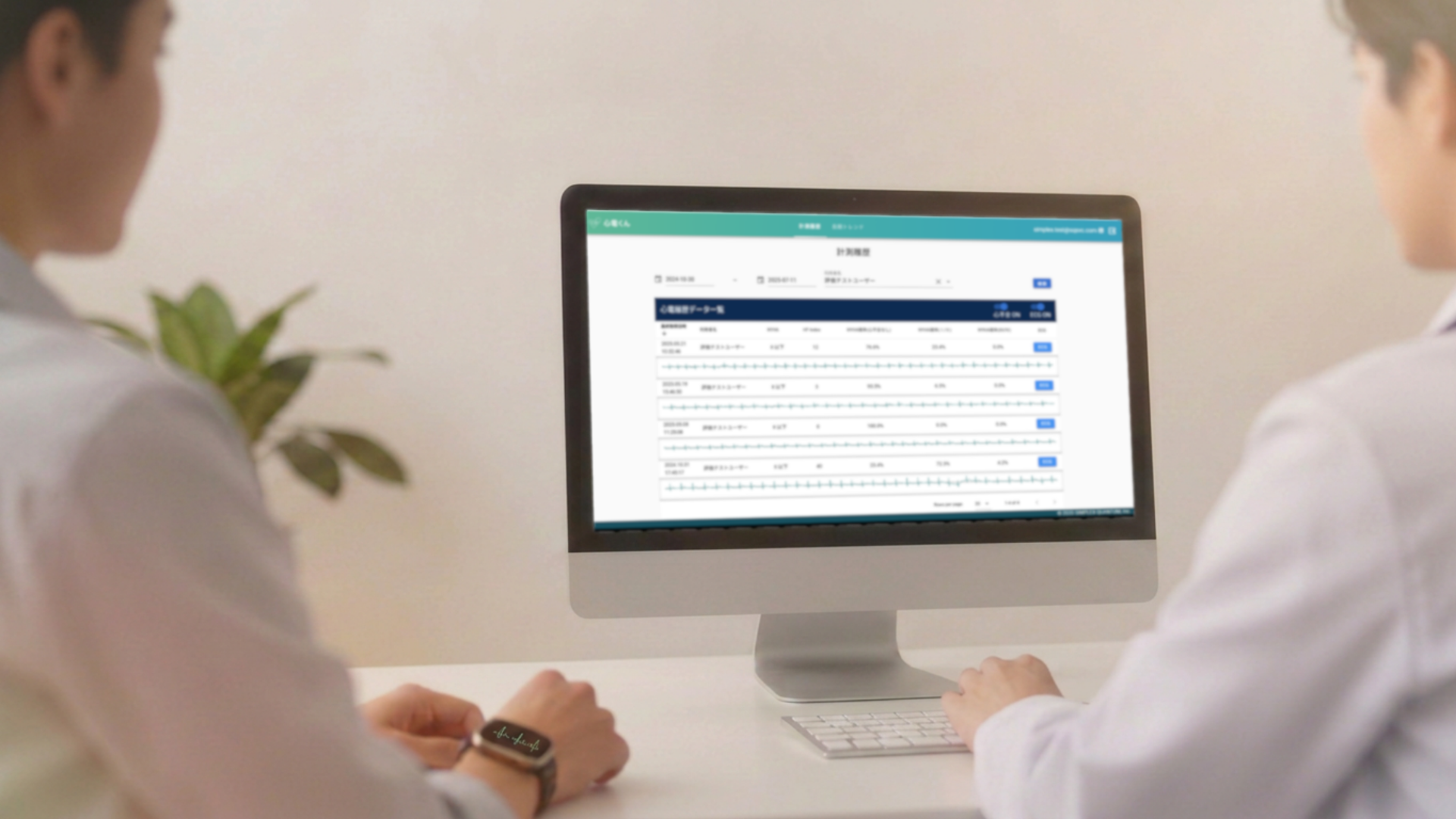
On a wearable, before any visit

Heart failure is often first identified in acute care, once symptoms have already become urgent. A possible future research direction: on-demand risk identification on a wearable for people who are at risk or starting to notice symptoms, before a first visit.

First Point of Care

Outpatient care

Acute admission

38% first diagnosed in acute care; where mortality is worse.1,2

Access

On a 12-lead ECG, wherever that first ECG is

An echo is hard to get: it needs a referral first. A 12-lead ECG is already done immediately for anyone with heart symptoms, whether that's acute or outpatient care. Putting risk identification on that ECG could give access at the first point of contact, either way.

Specialist Workup

BNP/NT-proBNP

Echocardiogram

Diagnosis

Specialist workup itself doesn't change here — but as risk is flagged earlier upstream, the time it takes to reach an echo and a diagnosis is intended to shorten.

Median 40 days to echo. Only 29% diagnosed within a year.3

GDMT + monitoring

Treatment, then follow-up

Monitoring

On a wearable, after diagnosis

After a patient is diagnosed, a dedicated monitoring algorithm on a wearable could watch for early signs of decompensation between visits, flagging risk before it turns into a readmission.

25% readmitted within 30 days, and 63% within one year.4

At risk

Stage A/B, asymptomatic

Symptoms begin

Often dismissed

Earlier

On a wearable, before any visit

Heart failure is often first identified in acute care, once symptoms have already become urgent. A possible future research direction: on-demand risk identification on a wearable for people who are at risk or starting to notice symptoms, before a first visit.

First Point of Care

Outpatient care

Acute admission

38% first diagnosed in acute care; where mortality is worse.1,2

Access

On a 12-lead ECG, wherever that first ECG is

An echo is hard to get: it needs a referral first. A 12-lead ECG is already done immediately for anyone with heart symptoms, whether that's acute or outpatient care. Putting risk identification on that ECG could give access at the first point of contact, either way.

Specialist Workup

BNP/NT-proBNP

Echocardiogram

Diagnosis

Median 40 days to echo. Only 29% diagnosed within a year.3

Specialist workup itself doesn't change here — but as risk is flagged earlier upstream, the time it takes to reach an echo and a diagnosis is intended to shorten.

GDMT + monitoring

Treatment, then follow-up

25% readmitted within 30 days, and 63% within one year.4

Monitoring

On a wearable, after diagnosis

After a patient is diagnosed, a dedicated monitoring algorithm on a wearable could watch for early signs of decompensation between visits, flagging risk before it turns into a readmission.

Publications

What the studies show.

Two published studies inform two of these directions: in-clinic HF identification and at-home disease monitoring.

JACC Identification Research Letter 2024

NIHA-HF: An Artificial Intelligence Solution for Heart Failure Diagnosis and Monitoring Based on Lead I Electrocardiogram

Chen Y · JACC: Basic to Translational Science · Research Letter · 2024

Trained on 28,000 Lead I ECGs (extracted from standard 12-lead ECGs) from approximately 11,000 subjects at the University of Tokyo Hospital, and tested on an independent dataset of 1,189 individuals.

Reported AUC of 0.9576 for overall HF and 0.9525 for the HFpEF subgroup.
Read paper →
IJC Monitoring Peer-reviewed 2025

Heart failure monitoring with a single-lead electrocardiogram at home

Hasumi E, et al. · International Journal of Cardiology · 2025

Classifies HF severity and tracks disease progression using single-lead ECG collected at home. Developed on data from 6,902 of 9,518 eligible participants, with a 100-patient prospective validation study.

Classified healthy, NYHA I–II, and NYHA III–IV with 91.6% accuracy; HF-Index correlated with BNP at R = 0.74 in patients without renal dysfunction or AF.
Read paper →

Let's talk.

We welcome inquiries from clinicians, researchers, investors, and potential partners.

Clinical Partnership Investors Press

References

  1. Sandhu AT, et al. Disparity in the setting of incident heart failure diagnosis. Circ Heart Fail. 2021.
  2. Taylor CJ, et al. Trends in survival after a diagnosis of heart failure in the United Kingdom 2000-2017: population based cohort study. BMJ. 2019.
  3. Anderson L, et al. Suspected de novo heart failure in outpatient care: REVOLUTION HF. Eur Heart J. 2025.
  4. Foroutan F, et al. Global comparison of readmission rates for patients with heart failure. J Am Coll Cardiol. 2023.